Calculate your SE tax
Your results
How it breaks down
| Net self-employment income (annual) | $0 |
| × 92.35% (IRS reduction factor) | $0 |
| Social Security tax (12.4%) | $0 |
| Medicare tax (2.9%) | $0 |
| Total SE tax | $0 |
What is self-employment tax?
When you work for an employer, they pay half of your Social Security and Medicare taxes (called FICA). When you're self-employed — whether you're a freelancer, gig worker, independent contractor, or small business owner — you pay both halves yourself. That's self-employment tax.
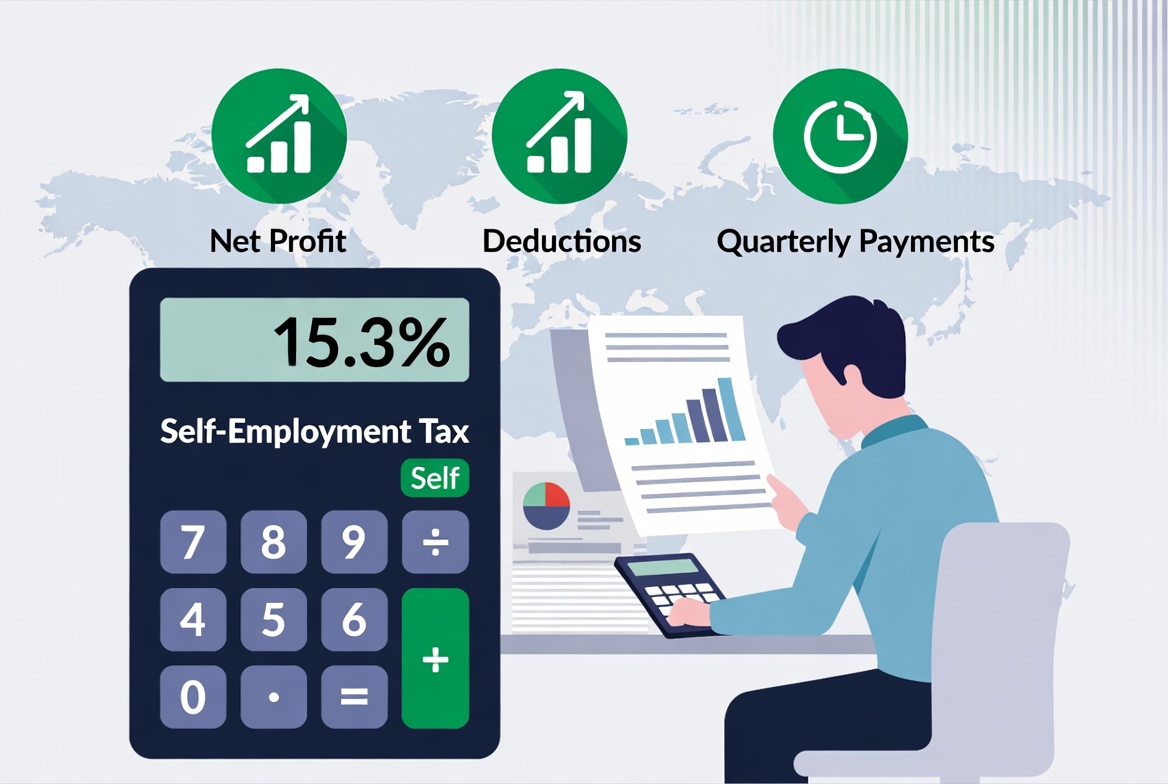
The total SE tax rate is 15.3%: 12.4% for Social Security and 2.9% for Medicare. But the IRS lets you apply it to only 92.35% of your net income (this accounts for the "employer half" deduction), so your effective rate works out to about 14.1%.
The SE tax deduction
The IRS allows you to deduct half of your SE tax from your gross income when calculating income tax. This is an "above-the-line" deduction — you don't need to itemize. Our calculator includes this automatically when the toggle is on.
Social Security wage base
In 2025, Social Security tax (12.4%) only applies to the first $176,100 of net SE income. Above that threshold, you only pay the 2.9% Medicare tax. High earners also pay an Additional Medicare Tax of 0.9% on income above $200,000 (single) or $250,000 (married).
How to pay it
SE tax is not withheld from your paychecks — you pay it yourself, either through quarterly estimated tax payments or when you file your annual return. We recommend paying quarterly to avoid penalties. Use our Quarterly Tax Estimator to find your exact payment amounts.
How to reduce SE tax
The only legitimate way to reduce SE tax is to reduce your net self-employment income — which means tracking and deducting all eligible business expenses. Mileage, home office, equipment, software, and professional services can all reduce your taxable income. Use our Mileage Deduction Calculator to see how much driving saves you.